 MBR City
 The Blue Line’s first tunnel was finished in two months, at 30 metres a day
Metro lines are not usually late because of the trains. They are late because of the hole, which is why the first tunnelling number of a project is the one worth reading.
What was completed
The RTA announced in July 2026 that the first phase of excavation on the Blue Line was complete, two months after tunnelling officially began. Tunnelling was inaugurated in May by Sheikh Mohammed bin Rashid. The machine has broken into its first station and continues towards Al Warqa.
The machine
Al Wugeisha — the name comes from the Arabic for the baskets pearl divers used — is 163 metres long and weighs around 2,000 tonnes. It excavates roughly 30 metres a day, more than double the rate achieved during construction of the original Metro, and installs its own tunnel lining segments as it goes.
The line
30 kilometres, of which 15 are underground. Fourteen stations connecting Mirdif, Dubai Silicon Oasis, Dubai Creek Harbour and International City, linking five urban regions: Bur Dubai and Deira, Downtown and Business Bay, Dubai Silicon Oasis, Dubai Marina and JBR, and Expo City. Cost, Dh20.5 billion. Opening date, 9 September 2029.
What it does to the network
On completion the Dubai Metro becomes 131 kilometres of track, 78 stations and 168 trains. The RTA projects a 20% reduction in road congestion. The Gold Line — 42 kilometres, around $9 billion, entirely underground — follows on 9 September 2032.
Thirty metres a day is a real number and a partial one. Tunnel boring rates are highest in uniform ground on a straight alignment and collapse near stations, cross-passages and utility crossings, where the machine stops for days at a time; a first drive between two points chosen to be straightforward is exactly where a project posts its best figure. The honest test comes on the drives that pass under existing infrastructure. For MBR City the more useful question is not the schedule but the map. The Blue Line serves the eastern arc of the city, and its value to a district on the Meydan side is indirect — it is an interchange proposition rather than a walk-to-the-station one, and the journey that improves is the trip to Creek Harbour or International City rather than the trip to Downtown, which the Red Line already does. Residents weighing a 2029 date against a purchase decision should also note the difference between a line opening and a line being useful: frequency, interchange walking times and the bus network feeding the stations are all decided much later, and they determine whether a nearby station changes anyone’s morning.
Source: The National checked against the source
More MBR City news
Blue Line reaches 26 per cent
Construction on the Dubai Metro's Blue Line stands at 26 per cent in early September, against a target of 30 per cent by the end of the year and an opening set for 9 September 2029.
The Gold Line is approved: 42 km, entirely underground
Dubai has approved a third metro line — 18 stations from Al Ghubaiba to Jumeirah Golf Estates, AED 34 billion, opening 9 September 2032. It interchanges with Etihad Rail at Meydan.
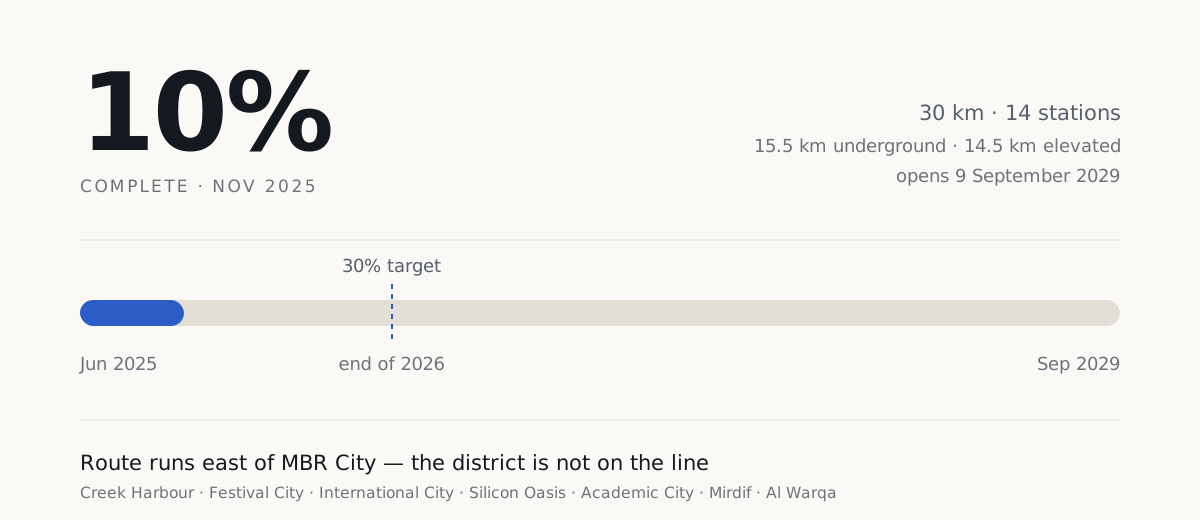
Metro Blue Line reaches 10%
Dubai's 30km, 14-station Blue Line hit 10% completion five months after breaking ground and is targeting 30% by the end of 2026, for a September 2029 opening — on a route that does not serve MBR City.